
HDHMR vs Plywood: Which Is Better for Modular Furniture?
Anyone who has sat through a furniture consultation in Kerala has probably heard the same debate come up: HDHMR or plywood? It sounds like a small technical detail, but it decides how your wardrobe holds up during the monsoon, how your kitchen shutters age over five years, and how much you end up paying for repairs down the line. Both materials have genuine strengths, and neither one is universally better, which is exactly why this comparison matters before you sign off on a design. This guide walks through what each material actually is, where it performs well, and where it falls short, so you can make a decision that fits your home rather than a generic recommendation.
What Is HDHMR?
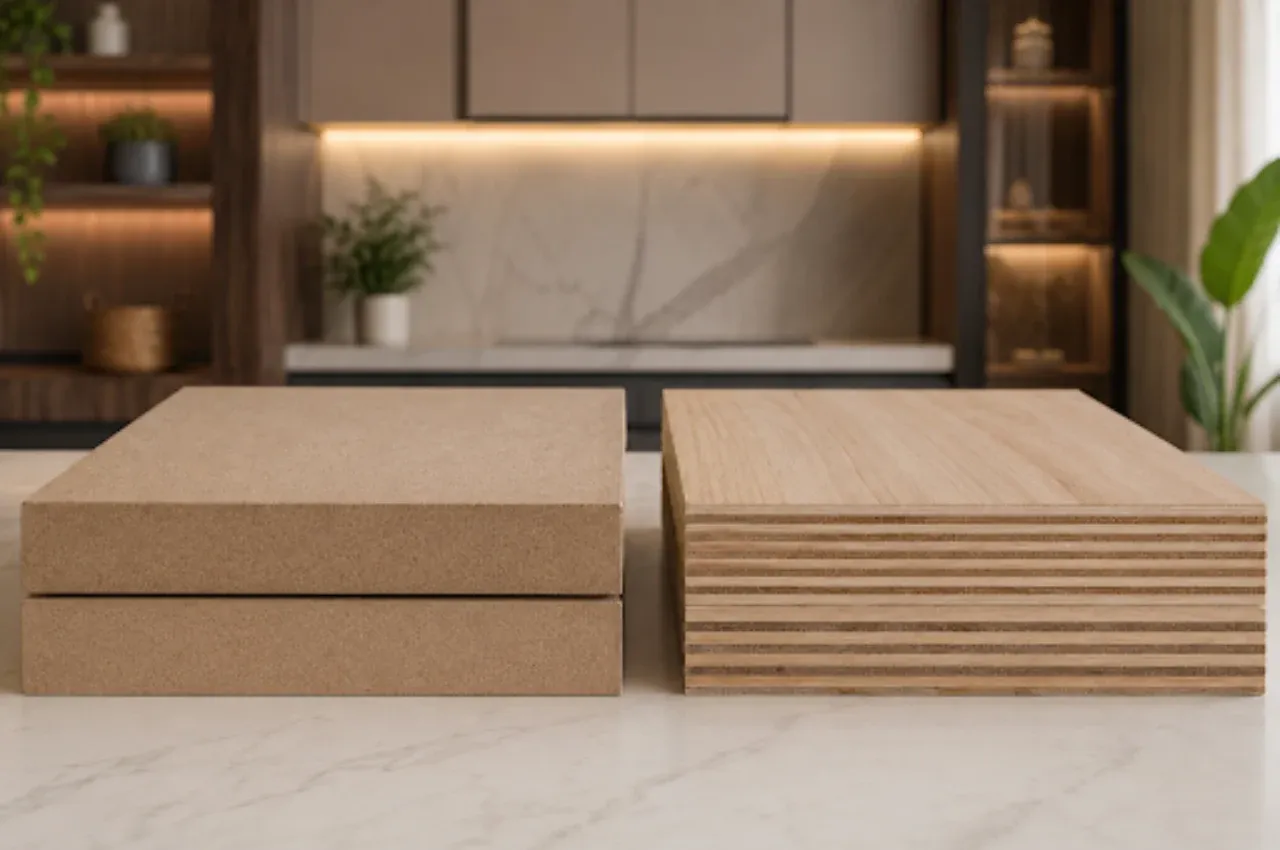
HDHMR, short for High Density High Moisture Resistant board, is made by compressing wood fibres under intense pressure and binding them with specialised resins. The result is a board with no visible layering, unlike plywood, which gives it a remarkably even, smooth surface straight out of the factory. Manufacturers favour it for CNC cutting because the density is consistent all the way through, so edges come out clean without chipping. That's part of why so many modular kitchen brands lean on HDHMR for shutters and cabinet doors; it takes laminate, veneer, and paint finishes evenly, and the final product looks sharp without needing extra finishing work.
What Is Plywood?
Plywood is built differently. Thin sheets of wood veneer are peeled from logs, stacked with each layer's grain running at ninety degrees to the one beneath it, and bonded together under heat and pressure. That cross-layered structure is the whole secret behind plywood's strength; it is what stops the board from warping or bowing the way a single sheet of solid wood might. Indian carpenters have relied on plywood for generations because it holds screws firmly, handles hardware well, and comes in a range of grades, namely MR, BWR, and BWP, each suited to a different level of moisture exposure.
HDHMR vs Plywood: Key Differences
At the core, the difference comes down to construction. HDHMR is one dense, fibre-based board, while plywood is built from multiple thin veneer layers glued together. That single distinction shapes almost everything else about how the two materials behave. HDHMR tends to deliver a smoother finish and holds its shape well in vertical applications like door panels and shutters. Plywood, on the other hand, offers better screw-holding strength and structural flexibility, making it a more suitable choice for load-bearing components or furniture that requires curved designs.
HDHMR vs Plywood: Detailed Comparison
Numbers and technical grades tell the story better than general statements do, so the table below lays out how the two materials stack up across the factors that actually matter in regular use. Some of these differences are minor, but others, particularly around moisture grading, can determine whether your furniture lasts five years or fifteen. Use this as a quick reference when discussing material options with your designer or contractor.
| Factor | HDHMR | Plywood |
| Construction | Compressed wood fibre, single dense board | Layered veneers, grain alternating at 90 degrees |
| Moisture resistance | Good in ventilated indoor spaces; performance varies by brand | Depends on grade: BWP (IS 710) survives 72 hours of boiling water, BWR (IS 303) around 8 hours, MR suited to dry areas only |
| Structural strength | Dense but not layered and less suited to load-bearing use | Strong under stress due to cross-layered construction; preferred for structural components |
| Surface finish | Smooth, uniform, ideal for laminate and paint | Slight grain texture may show through certain finishes |
| Weight | Heavier per sheet | Comparatively lighter and easier to handle |
| CNC and cutting | Precise, clean edges due to uniform density | Good, though edge quality depends on veneer grade |
| Typical cost | More budget-friendly | Ranges from affordable (MR) to premium (BWP/marine) |
| Best suited for | Wardrobe shutters, kitchen cabinet doors, vertical panels | Cabinet carcasses, shelves, bases, load-bearing furniture |
Pros and Cons
Weighing the advantages against the drawbacks is often the fastest way to see which material fits a specific room or application. Neither HDHMR nor plywood comes out ahead on every count, which is precisely why most experienced designers use a mix of both rather than committing to one across an entire project. Here is how the two compare side by side.
HDHMR
- Smooth, uniform surface that finishes cleanly with laminate or paint
- Strong moisture resistance for indoor, well-ventilated spaces
- Precise CNC compatibility with minimal chipping
- Relatively budget-friendly compared to premium plywood
- Lower structural strength for load-bearing applications
- Heavier per sheet than plywood
Plywood
- Excellent structural strength from cross-layered construction
- Dependable screw holding and hardware fixing
- Long-term durability, especially in higher grades
- Flexible enough for curved or custom furniture designs
- Moisture resistance varies significantly by grade
- Marine or BWP grade options come at a noticeably higher cost
HDHMR or Plywood: Which Is Better for Kerala Homes?
Kerala's climate does not make this an easy either-or decision. Sustained humidity through most of the year, followed by heavy monsoon rainfall, puts real pressure on furniture materials, and a choice that works fine in a drier state may not hold up here. For wardrobe shutters, kitchen cabinet doors, and other vertical panels in rooms with reasonable ventilation, HDHMR generally performs well and keeps that clean, modern look intact for years. For carcasses, shelves, bases, and anything installed in areas with moisture exposure, BWR or BWP grade plywood is the safer route. In practice, most well-planned modular projects across Kerala use both materials together, assigning each to the role it handles best.
Factors to Consider Before Choosing
Before locking in a material, it helps to run through a short checklist rather than deciding on finish alone. These are the questions worth asking your designer at the planning stage.
- Application: Is this piece a shutter, a base, or a load-bearing shelf?
- Moisture exposure: How humid or wet does the room get, especially kitchens and bathrooms?
- Finish preference: Do you want the smoother laminate finish HDHMR typically offers?
- Budget versus longevity: Are you optimising for upfront cost or for how the material performs over ten to fifteen years?
- Certification: If choosing plywood, has it been checked for proper IS 303 or IS 710 grading and an ISI mark?
How Lemon Interiors Selects the Right Material
We do not apply one material across every project at Lemon Interiors. Instead, each space is assessed on its own requirements. Our designers look at moisture exposure, structural load, budget, and the finish a client is aiming for before recommending HDHMR, plywood, or a considered mix of both. As interior designers in Kerala, we have seen firsthand how local humidity and monsoon conditions affect material performance over time, and this experience directly shapes how we specify materials for every wardrobe, kitchen, and modular unit we build.
If you are planning a new interior project and want guidance grounded in real local experience, our team of interior designers in Kochi at Lemon Interiors is ready to help. Visit Lemon Interiors to see our work and get in touch with our design team.